
Clinic Glass Partitions in Dubai: Healthcare Fit-Out Planning Guide
Plan clinic glass partitions in Dubai with practical guidance on privacy, safety glass, doors, aluminium framing, cleaning, approvals, and live healthcare fit-out coordination.
Quick answer
Clinic glass partitions in Dubai should be planned around patient privacy, safe movement, cleaning routines, door performance, and fit-out sequencing. A healthcare partition is not only a transparent wall; it affects consultation comfort, reception visibility, corridor flow, acoustic control, infection-control cleaning, and how quickly the clinic can open or renovate without disrupting appointments.
For clinics, dental practices, aesthetic centres, therapy rooms, labs, pharmacies, and medical branches, the practical route is to coordinate glass partition installation, internal partitions, acoustic doors and partitions, and related aluminium or door hardware before drawings are finalized.
Where glass partitions work best in clinics
Glass partitions are useful where healthcare interiors need separation without making the space feel closed or dark. Reception counters, waiting areas, consultation rooms, treatment rooms, nurse stations, optical zones, admin offices, corridors, and laboratory viewing areas can all benefit from controlled visibility and better daylight.
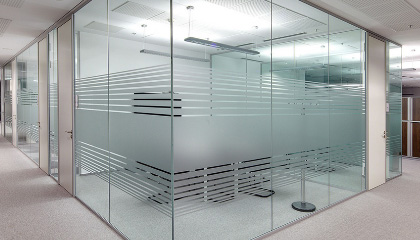
The right layout should support patient movement and staff supervision without exposing private discussions or treatment activity. Clear glass may suit reception and staff areas, while frosted, etched, filmed, or acoustic glass may be better for consultation rooms and spaces where privacy matters.
- Reception and waiting areas that need visibility with a cleaner front-of-house look.
- Consultation and treatment rooms where privacy, speech control, and hygiene matter.
- Admin offices, manager cabins, and nurse stations inside active healthcare spaces.
- Pharmacy, optical, laboratory, or diagnostic zones that need controlled separation.
- Clinic branches in malls, towers, villas, and medical centres across Dubai.
Start with privacy and patient comfort
Many clinic partition problems begin when clear glass is selected for every room. Healthcare spaces often need different privacy levels from one area to another. Reception glazing can remain open and bright, but consultation rooms, therapy rooms, dental operatories, and procedure spaces may need partial frosting, manifestation, blinds, switchable privacy glass, or acoustic build-ups.
A practical partition schedule should mark each room by use: public, staff-only, confidential, treatment, wet-area-adjacent, or equipment-heavy. This makes it easier to choose the glass finish, door type, frame detail, seals, and hardware without overbuilding simple areas or under-specifying sensitive ones.
- Identify rooms where patients may discuss private medical or payment information.
- Use frosting, film, etched glass, or manifestation where clear glass is too exposed.
- Review acoustic glass for consultation rooms, therapy rooms, and manager cabins.
- Plan door gaps, seals, and closers because privacy often fails at the door.
Choose safety glass for daily healthcare traffic
Clinics have steady movement from patients, staff, trolleys, cleaning teams, and sometimes children or elderly visitors. Partition glass should therefore be selected for the real traffic pattern, not only for appearance. Toughened, laminated, or acoustic laminated glass may be appropriate depending on panel size, door location, impact risk, and privacy requirement.
For doors, sidelights, corridor glazing, and full-height panels, exposed edges, handles, patch fittings, hinges, and floor tracks should all be reviewed together. A useful comparison is toughened vs laminated glass in Dubai, especially where post-breakage behaviour, patient safety, or acoustic control matters.
- Match glass build-up to panel height, width, support method, and location.
- Review laminated glass where retention after damage is important.
- Protect exposed corners near corridors, waiting areas, and treatment-room doors.
- Avoid door and partition hardware that creates snag points or hard-to-clean gaps.
Door performance decides how the room feels
A clinic partition is only as good as its door. Hinged glass doors, framed aluminium doors, sliding glass doors, and acoustic doors all behave differently in daily use. The right choice depends on corridor width, room size, accessibility, privacy, cleaning, and how often staff move between rooms.
Door alignment, closer speed, handle position, seals, locksets, access control, and bottom gaps should be checked before fabrication. If an existing clinic has doors that drag, slam, leak sound, or fail to close, it may need door and window alignment or hardware replacement alongside the partition work.
- Use hinged doors where sealing and controlled closing are more important.
- Use sliding doors carefully where space is tight but privacy expectations are lower.
- Coordinate locks, privacy latches, access control, closers, and handles early.
- Check wheelchair movement, trolley access, and corridor clearance before approval.
Cleaning and maintenance should shape the details
Healthcare interiors are cleaned frequently, so partition details should avoid dirt traps and fragile finishes. Bottom channels, recessed tracks, silicone joints, frame corners, hardware finishes, film edges, and door thresholds should be selected with maintenance in mind.
Glass can be a practical clinic material because it is smooth, durable, and visually light, but only if the installation can handle daily wiping, disinfectant exposure, fingerprints, trolley movement, and quick inspection. For high-use clinics, a slightly more robust framed or semi-framed system can be more practical than the most minimal frameless detail.
- Prefer cleanable channels, frames, handles, and exposed edges.
- Confirm whether privacy film or manifestation can withstand frequent cleaning.
- Avoid floor details that trap dust or block easy cleaning routes.
- Plan maintenance access for closers, locks, seals, and movable panels.
Coordinate partitions with MEP, ceilings, and approvals
Clinic partitions rarely stand alone. They meet ceilings, lights, HVAC diffusers, sprinklers, smoke detectors, power points, data outlets, medical equipment, signage, and sometimes lead-lined or specialist room requirements. If these elements are not coordinated, the glass line may conflict with services after fabrication has started.
For healthcare projects, the partition package should be reviewed with the fit-out contractor, MEP team, landlord or mall, and clinic operator before final measurement. This is especially important for live renovations, mall clinics, tower clinics, and medical centres where access, approvals, work hours, and infection-control requirements can affect sequencing.
- Confirm finished floor level, ceiling height, bulkheads, and service routes.
- Coordinate lighting, HVAC, sprinklers, detectors, switches, and signage.
- Check landlord, mall, building-management, and healthcare fit-out requirements.
- Plan noisy work, delivery access, protection, and cleaning around clinic operations.
What to send before requesting a clinic partition quote
A faster quote starts with a room-by-room brief. Share the clinic layout, marked partition lines, room names, approximate heights and widths, preferred door types, privacy expectations, acoustic needs, photos of the existing space, ceiling details, floor finish, and target opening date.
If drawings are available, include plans, elevations, reflected ceiling plans, door schedules, finish schedules, MEP constraints, landlord manuals, and any healthcare operator requirements. It also helps to mention whether the project is a new clinic, branch refresh, live renovation, or part of broader healthcare and medical facility planning.
- Marked floor plan with partition lines, room names, doors, and reception areas.
- Photos of floors, ceilings, walls, access routes, and any existing partitions.
- Privacy level for each room: clear, frosted, filmed, acoustic, or mixed.
- Preferred hardware finish, frame colour, door type, locks, and access control needs.
- Project location, working-hour limits, approval requirements, and opening deadline.
How Glass World can help
Glass World supports clinic glass partitions, internal partitions, acoustic glass systems, aluminium framing, doors, glass fabrication, replacement, and installation planning across Dubai and the UAE. The team can review the room layout, recommend practical glass and hardware options, coordinate fabrication, and help sequence installation around healthcare fit-out constraints.
The next step is to share drawings, photos, dimensions, privacy requirements, and timing. Glass World can then guide the scope toward a clinic partition package that balances patient comfort, safety, cleaning, durability, and a professional healthcare interior.

Glass Door Lock Repair in Dubai: Patch Locks, Handles, and Access Control Guide
Plan glass door lock repair in Dubai with practical guidance on patch locks, strike alignment, handles, access control, safety glass checks, and replacement quotations.
Read article
Curved Glass Cost in Dubai: Bent Glass Design and Quotation Guide
Plan curved glass cost in Dubai with practical guidance on radius, templates, glass build-up, fabrication, framing, transport, installation, and comparable bent glass quotations.
Read article
Shopfront Glass Cost in Dubai: Retail Installation and Replacement Guide
Plan shopfront glass cost in Dubai with practical guidance on glass specifications, aluminium framing, doors, mall approvals, access, installation, replacement, and comparable quotations.
Read article